Posts

Showing posts matching the search for Satellite Technology

Deep Dive

×
EXPLORE THE COSMOS
2026

Ace Your JEE Mains

HOW AMAZON AWS BECOME THE MARKET LEADER OVER OTHER CLOUD SERVICES

Image
 What is Cloud Computing? ☁ Cloud computing is the delivery of different services through the Internet. These resources include tools and applications like data storage, servers, databases, networking, and software. Rather than keeping files on a proprietary hard drive or local storage device, cloud-based storage makes it possible to save them to a remote database. One of the Cloud Service providers is AWS — Amazon Web Services. We don’t need to pay any upfront amount; AWS offers pay-as-you-go pricing — which enables you to pay only for what you use. Once you stop your usage, there is no fee to terminate, and billing stops immediately. Concept behind Cloud Computing Technology: Now let’s talk about what is the concept behind cloud computing. We need to go through some steps for this. Let’s understand the following: There are basic three ways to install Operating System. 1. Bare Metal 2. Virtualization 3. Containerization In Bare Metal you directly install the OS to ...
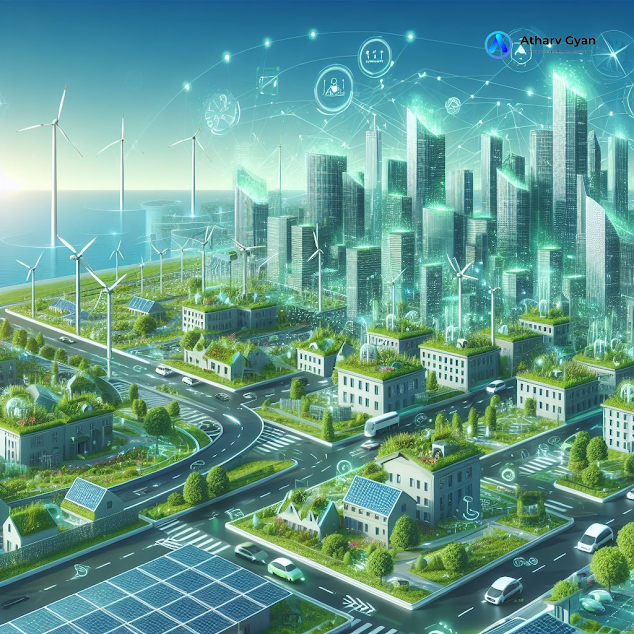
Artificial Intelligence in Sustainable Development

Image
Artificial Intelligence (AI) has emerged as a powerful tool with the potential to revolutionize various aspects of society, including sustainable development. As the world grapples with pressing environmental and social challenges, AI presents a unique opportunity to address these issues in innovative ways. From optimizing resource management to enhancing decision-making processes, AI can play a significant role in advancing sustainability goals across multiple sectors. One of the key areas where AI can contribute to sustainable development is in environmental conservation and management. AI-powered algorithms can analyze vast amounts of data from sources such as satellite imagery, sensors, and weather forecasts to monitor environmental changes and identify patterns. This data-driven approach enables more accurate predictions of phenomena like deforestation, habitat loss, and climate change impacts, allowing policymakers and conservationists to develop targeted interventions and mitiga...

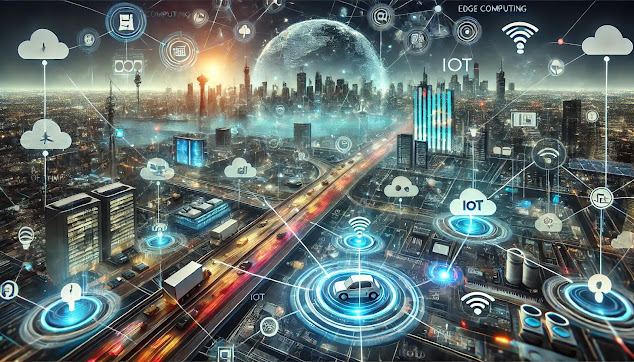
Edge Computing Bridging the Gap Between Cloud and IoT

Image
Edge computing is a decentralized computing model that processes data closer to the source where it is generated (the "edge" of the network), rather than sending it to centralized data centers or cloud servers. This model is particularly beneficial in scenarios involving the Internet of Things (IoT) , where real-time processing, low latency, and bandwidth efficiency are critical. Key Features of Edge Computing Proximity to Data Source : Edge devices, such as IoT sensors or gateways, process and analyze data locally rather than sending it to the cloud.  Reduced Latency : By processing data near its source, edge computing minimizes delays, which is essential for time-sensitive applications like autonomous vehicles or industrial automation. Bandwidth Optimization : Only critical data is sent to the cloud for further analysis or storage, reducing the load on networks. Enhanced Security and Privacy : Since data is processed locally, it reduces the risk of interception during tra...

Quantum Cloud Computing: Exploring the Intersection of Quantum Computing and Cloud Infrastructure

Image
Quantum computing, with its promise of unprecedented processing power and capabilities, is poised to revolutionize various industries. One area of particular interest is its intersection with cloud computing, where the combination of quantum computing's computational prowess and the scalability of cloud infrastructure holds immense potential. This paper explores the concept of Quantum Cloud Computing (QCC), examining how quantum computing principles can be integrated into cloud infrastructure to unlock new possibilities in data processing, security, and optimization. Understanding Quantum Computing: Quantum computing leverages the principles of quantum mechanics to perform computations in ways fundamentally different from classical computing. Unlike classical bits, which can be either 0 or 1, quantum bits or qubits can exist in a superposition of states, allowing for parallel computation and exponential increase in processing power. Furthermore, entanglement enables qubits to be co...
Atharv Gyan Splash Screen
🔍 DevTools is open. Please close it to continue reading.